Oftentimes alongside
This time: some longish function words, The Prodigal Tongue for English learners, and links to make you go hmmmm....

Hello and thanks for reading Separated by a Common Newsletter!

Alongside and oftentimes
This month’s blogpost looks at the spread of the preposition alongside, from nautical jargon, to general British-English usage, to its increasing presence in American English.
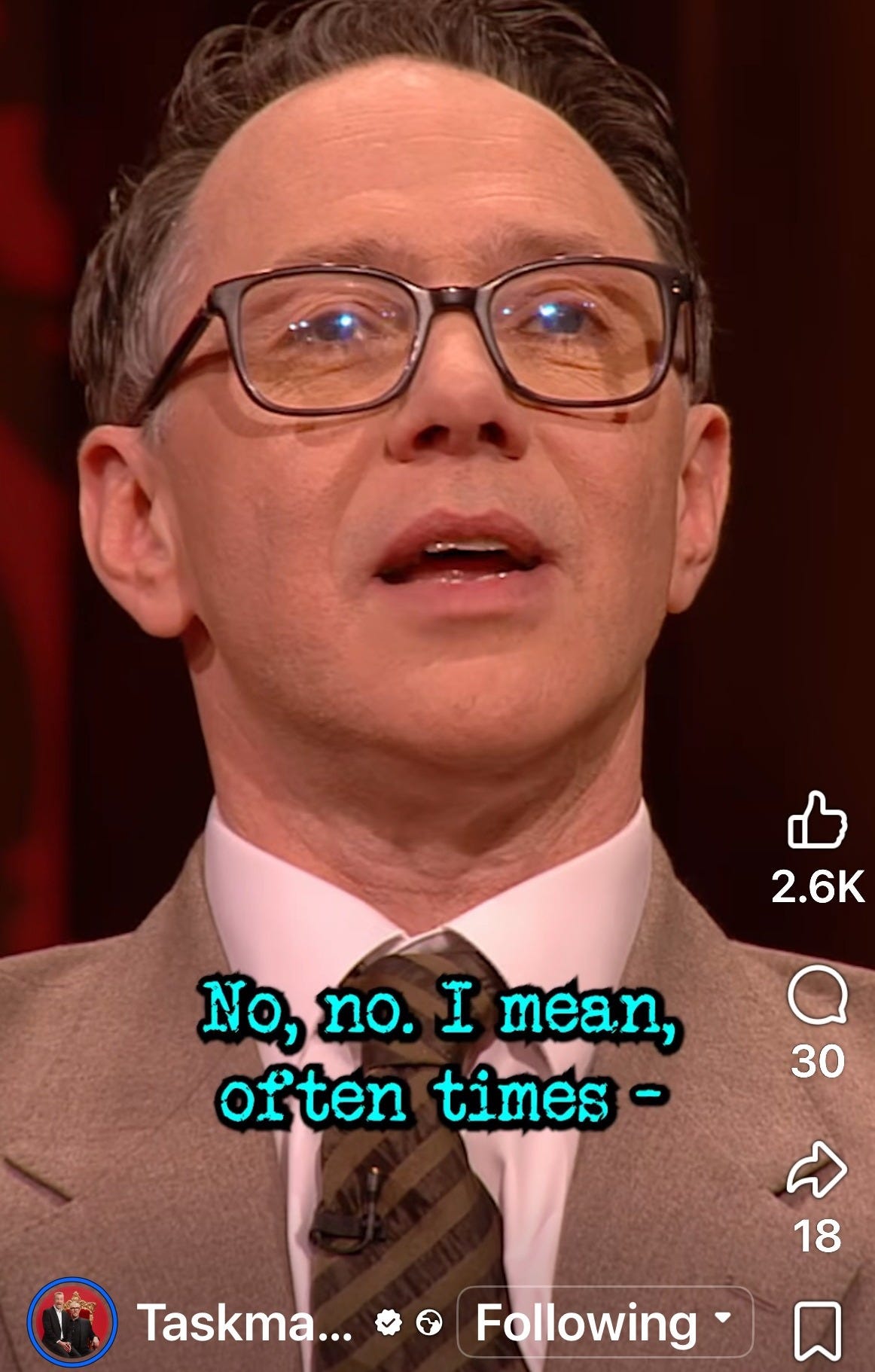
When I started researching the post, I’d thought that I’d compare it to oftentimes, another word that can seem “too long”, and which seemed to be moving transatlantically. Complained-about in some UK fora as an Americanism, I felt like I was hearing it more and more in the UK (like on Taskmaster, where the subtitler wasn’t quite sure how to spell it):
I ended up not including oftentimes in the post, because the corpus results didn’t mirror alongside’s. On average, oftentimes is used more on UK news sites after 2017, but it has a much more up-and-down profile:
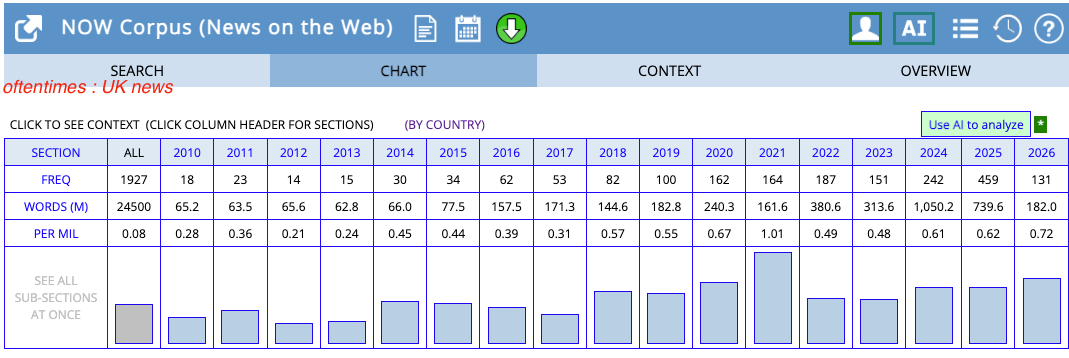
Oftentimes remains a more American than British expression. If I’ve noticed it more in the UK now than 20 years ago, that only seems to be because the word is used more everywhere now. The difference between British and American usage seems steady.
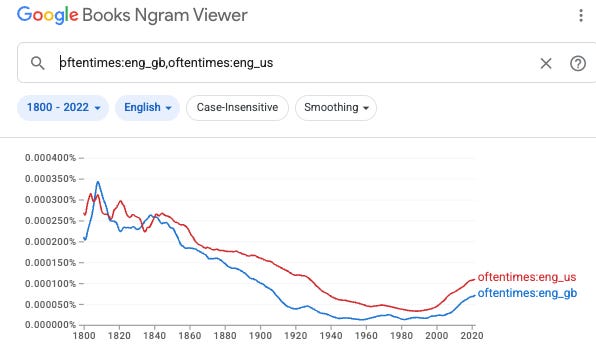
(It doesn’t matter if I search for often times with a space instead—it’s still more American.)
The trend in alongside does show American English being more Britified, though. I’ll leave you to read about that at the blog:
Good reads
Falsehoods programmers believe about languages (Lexiconista): Some of these falsehoods are things that non-programmers might believe too, and others are things you might not bother to have a belief about—till you think about how facts about English have led aspects of computation and user-interface design.
How rightwing rhetoric has risen sharply in the UK parliament: a visual analysis (Guardian): No matter the party affiliation, everyone’s doing it.
The Welsh language has become more vulnerable (Guardian): the number of speakers is not keeping up with population growth.
Why English spelling does make sense (Colin Gorrie):

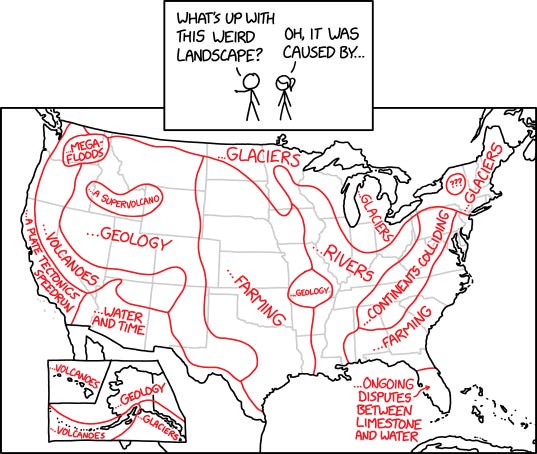
And a quick visual explainer of US landscapes from xkcd:
The US/UK expressions quick-fire round
alumin(i)um [BrE & AmE: Not One-Off Britishisms]
boondocks [AmE: WordOrigins.org]
got it in for me [General English, but with added Kenneth Williams: The Stroppy Editor]
lam, on the [orig. AmE criminal slang: WordOrigins.org]
Turtle Island [calque from Native American languages: WordOrigins.org]
understand, as in The BBC understands that… [UK media-ish: Language Log]
plus lots of British regional words for alleyways [Language Log]
Listen/watch here
Video John McWhorter on ‘The Cult of the Casual’ in speech (New York Times)
Podcast series Understand: How Reading Made Us (BBC Radio 4, four very good parts; also available through BBC Sounds, Apple Podcasts, etc.)
Podcast episode He was deaf for 35 years: about the experience of getting a cochlear implant later in life (Twenty Thousand Hertz)
Play
Can you solve these language puzzles? Test your skills with these problems from North America’s biggest linguistics competition (Scientific American)
From the archives
Since this month’s blogpost is about a preposition, here are past posts about some prepositions with longer and shorter versions.
(a)round (May 2007)
off (of) and out (of) (March 2010)
toward(s) and other -ward(s) (July 2013)
Joke of the month
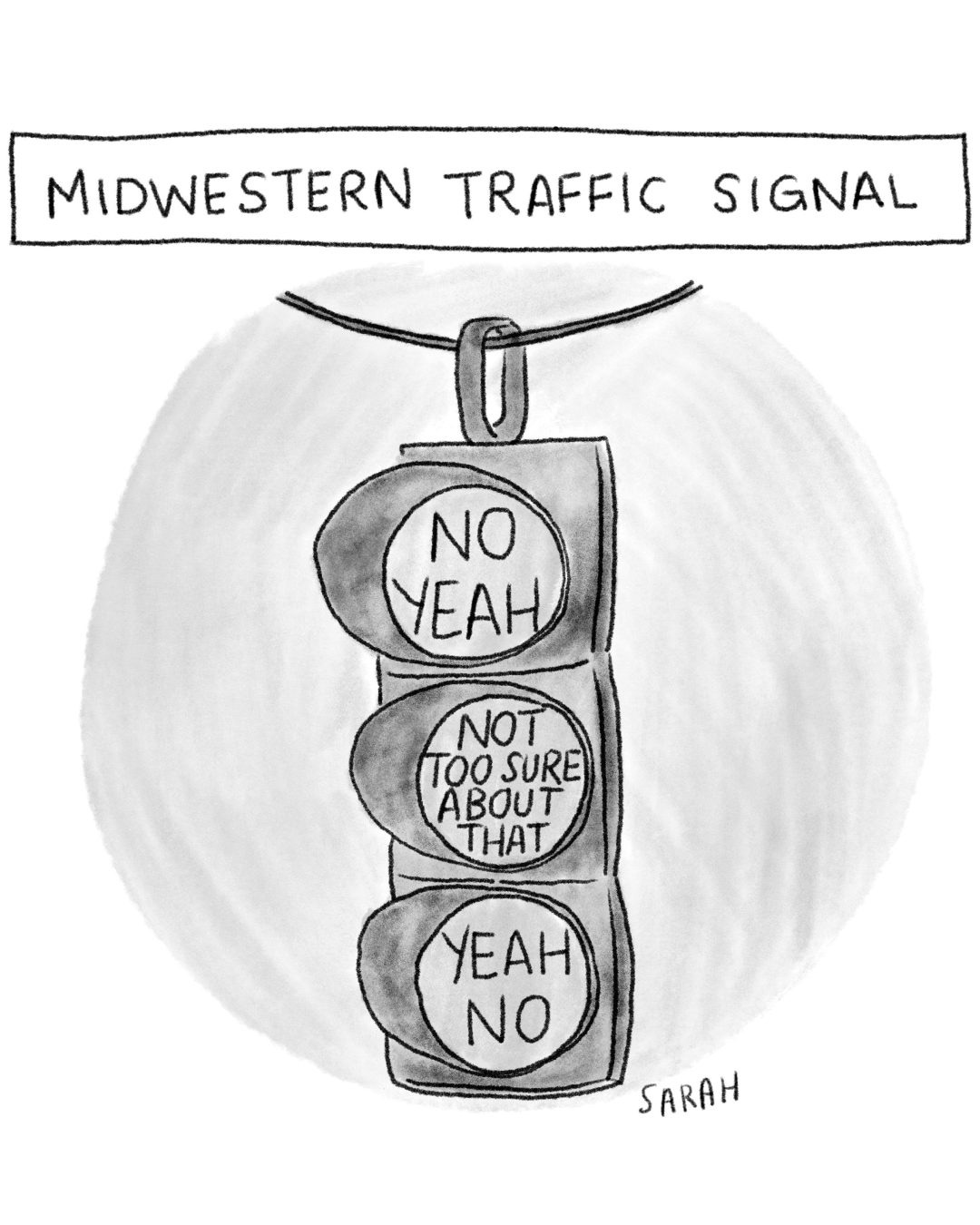
A cartoon by Sarah Kempa via The New Yorker Facebook page:
And in my life…
Suddenly, there seems to be interest in my eight-year-old book, The Prodigal Tongue, on English-learning YouTube. First, there was this discussion of it on a Chinese site:
My Chinese is certainly not good enough to follow that, but it’s fun to see some familiar examples from the book in it.
Another site (Unique English Skills) offers it as a ‘slow story’ in Simple English. Here, the resemblance to the actual book is more spiritual than textual. But I love the general message for English learners in it: your English is your English. It doesn’t need to be like the British or American standards.
What I’ve been thinking about: creative classroom assessment—not just to ensure that work is student’s own (and not an AI’s) but also to build community in an undergraduate cohort. Genius ideas welcome.
What I’m reading: I’m 10% into Richard Zenith’s Fernando Pessoa: an experimental life and loving it. But it’s well over 900 pages long, so you can expect to hear about it again next month! (Because I’m also reading a lot of student essays.)
What I’m writing: Still writing up my article on the use of articles in dictionary definitions, but also (excitedly) writing a proposal for a reference book.
Where I’ve been: I’ve made a resolution to go to all of the (year-round*) comedy venues in Brighton. I’ve managed to get to three in March! Many more to come. (*Year-round because once the Brighton Festival starts, the number of comedy venues is roughly uncountable.)
What I’m celebrating: That I work at a university where there’s a three-week break in teaching for Easter! Looking forward to a traipse around London with an American friend.