Getting SHOUTY!
This time: how a BrEism is developing in AmE and so many other links

Hello and thanks for reading Separated by a Common Newsletter!

SHOUTY man, SHOUTY writing, SHOUTY singing
This month’s blogpost was inspired by Jody V, who had noticed the BrEism shouty in the New York Times. It can be used of people—for instance, my daughter used to complain to me about shouty teachers. The UK children’s programme/show Horrible Histories did infomercial parodies with Jim Howick playing Shouty Man.
As I traced uses of the word through various corpora, it struck me that the adjective increasingly refers to written behavio(u)r rather than spoken. You can send someone a shouty text or have a shouty exchange on social media. Usually, this indicates writing in SHOUTY ALL-CAPS.
But in the American data, there was relatively more usage referring to shouty vocals in music—and perhaps it’s a specific concern in musical theat{er/re} (see this video instruction). Press the button if you want to see more about it:
(And if you want to know what else I’ve been up to, that’s at the end of this post.)
Good reads
“Scrabble in North America is a mess. Is it finally time to join the rest of the world?” Stefan Fatsis writes in Separated by a Common Language (Part 1) In Part 2, he proposes his solution to that mess and quotes me a bit—generously referring to me as a tournament Scrabble player. Regrettably, it’s been a long time since a tournament has seen me. (But I’m always up for a game.)
Guardian columnist Tim Dowling is another American who’s been living in British English for a long time, and he still gets lost in translation.
John McWhorter looks into the sound of the British American colonists in “The British Used to Sound Like We Did” [New York Times]
US and UK lawyers sometimes have to work together, and this article makes it seem like they don’t really enjoy it. As myself and others discussed on Bluesky, Kind regards is a particular bone of contention. Despite my 26 years in the UK, I’m still feeling the American feelings about this way of closing an email. [Legal Cheek]
Why do Americans still like the trappings of aristocracy, 250 years after rejecting it? Helen Lewis investigates in The Atlantic [gift link]
As interesting as a house on fire: Keeping score on similes in fiction. [The Pudding]
“Space is hard” —Duke University’s Dr. Dinin on why, generally, it’s good to avoid generalities
New research
In a study of Vietnamese students of English, Thi Mai Thi Tran found that American English, rather than Asian Englishes, constituted most of the students’ “input, preference, and perceived acquisition,” but that on more grammatical-discourse measures (past tenses and deontic modality), their English patterned more with British English. [in Asian Englishes journal, behind paywall]
A study by Amanda Cole and Ella Jeffries found that students attending online classes during Covid-19 still shifted their accents some, as they might have (done) if they had gone to uni in person—contradicting the assumption that face-to-face interaction is needed for accent change. [In English Language Contacts and Change in the Digital Age, open access]
And the US/UK expressions quick-fire round
biscuit/cookie [BrE/AmE, Word Origins; my old posts on the topic are Baked Goods and Zweibacks, Rusks and More on Biscuits]
bleachers [AmE, Word Origins]
chips/crisps/Saratoga potatoes [AmE/BrE, Word Origins; plus my old post]
football [BrE, Mashed Radish]
hush puppy [AmE, Word Origins]
Knick(erbocker)s [AmE, Mashed Radish]
moving house [BrE, Not One-Off Britishisms; plus my post about moving]
on the nose [BrE/AusE difference, Endangered Languages, via Peter Austin]
scallywag [AmE, Word Origins]
stump [AmE use, Word Origins]
with [pronunciation; AmE/BrE Erik Singer video]
Listen/watch here
Last time, I mentioned this 99% Invisible series on the History of the US in 100 Objects. I mention it again to feature a linguistic episode, on Noah Websters’s Blue-Back Speller and its role in African American literacy.

Lost in the Pond on how to linguistically profile Canadians:
How UK counties got their names:
A history of Lorem Ipsum [filler text]
From the archives
It’s coming up, so here’s my old post about the 4th of July.
Joke of the month
And in Lynneguistland…
What I’ve been thinking about: Englishness—because I was on the on the OffScript podcast in their ‘Albion’ series talking about it. It occurred to me that, besides sports teams, the only really English (as opposed to British) national institution is the Church of England. As someone raised on the idea of separation of Church and State, it kinda gives me the heebie-jeebies.
What I’ve been reading: a PhD thesis about how (we can study how) word meanings varied among practitioners of different religions in Early Modern England. It was excellent for its observations about how meanings travel (or don’t) and for its demonstration of how this can be studied in the distant past. I send my congratulations to the newly minted Dr O’Hara-Brown.
What I’ve been talking about: On BBC Radio 4’s PM program(me), I got to talk about whether many now-American words used to be used in Britain. If you’ve read The Prodigal Tongue, you’ll know many of my go-to examples. (If not, then now’s your chance!) I also chatted to BBC 5 Live’s Nicky Campbell on Don’t Say a Word about the origins and use of ethnic idioms, like go Dutch and French leave.
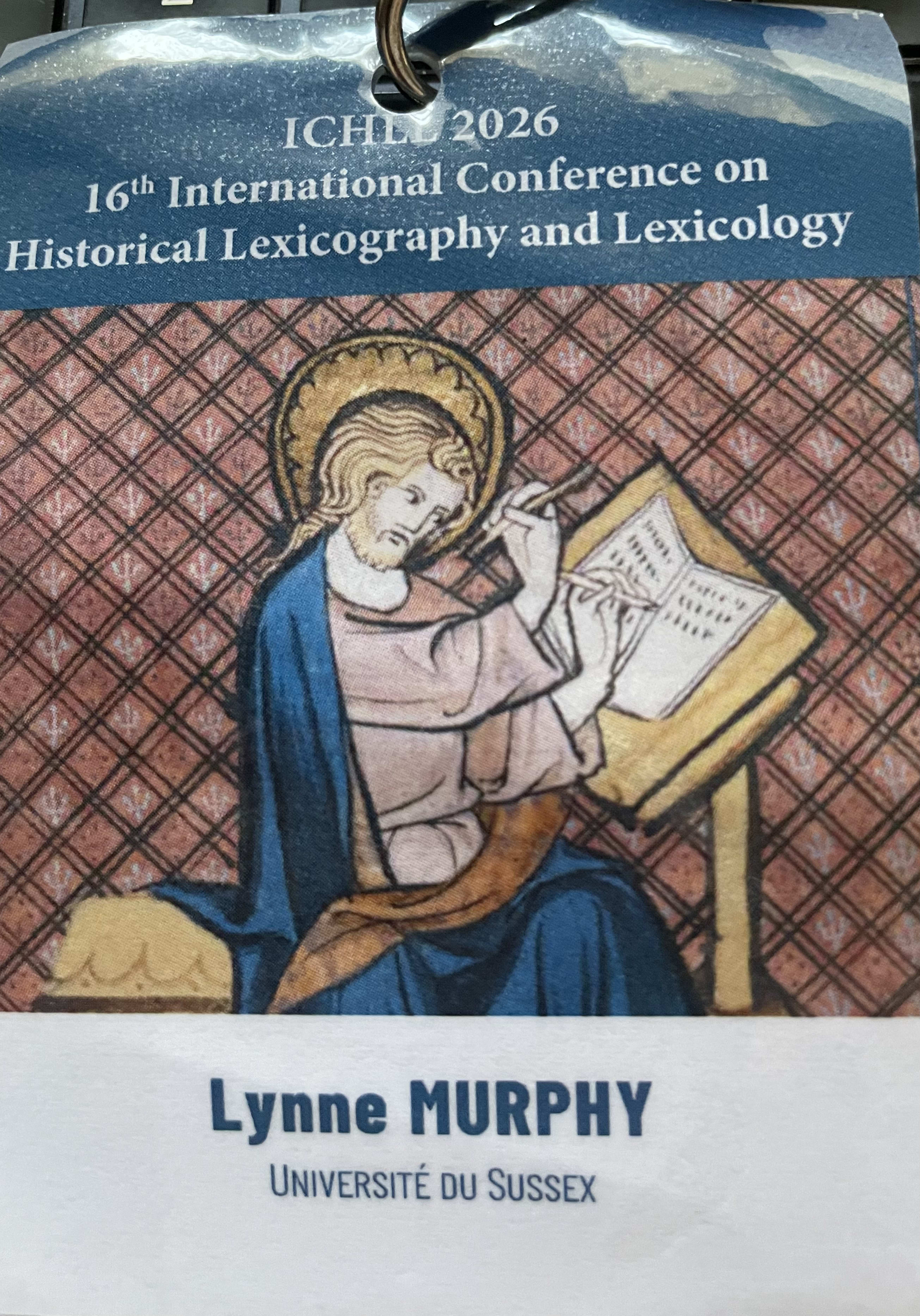
Where I’ve been: in Caen, France for very hot weather and the always wonderful International Conference on Historical Lexicography and Lexicology. (New experience: travel(l)ing by overnight ferry. Much recommended.)
I like the this adjective is being used in both ora and written communication, and extending it's move into the digital expressions
Kind regards is essential. You can always retreat to "Regards" if they piss you off, or worse, leave off the sign off altogether. If you're still getting the kind, you know you're not that annoying.