fine lines
This time: read all the way to the bottom, it's the small print!
Hello and thanks for reading Separated by a Common Newsletter!

the fine/small print
This month’s blog post notices that Americans tend to talk about reading the fine print and Britons tend to talk about reading the small print. Or, more likely, not reading it.
The blessing of Substack is that I can’t make the print any smaller than this. No terms and conditions, just lots of information.
What else I’ve been up to
It’s that time of year when I’m asked if I’ve ‘finished working’ for the summer. And anyone who asks gets a rant: only undergraduate students get the summer ‘off’ from university! Teaching is supposed to account for 40% of my workload. If you’re wondering what else we academics get up to, here’s linguist Martin Hilpert explaining what our jobs involve. If you skip to the 4-minute mark, you’ll hear about the stuff that we have to squeeze into our non-teaching time—alongside the preparation for next term and (BrE) marking/(AmE) grading from the previous term. So, summer is the time to move forward, as quickly as possible, to do the parts of work that are harder to do with a heavy teaching schedule.
This summer is also full of ‘goodbye’ parties for people leaving the university in order to help it balance its budgets. Academia is not the cheeriest place to be these days.
Good reads
The Linguistics Institute at Henrich Heine University has made a Summer Reading List for language lovers.
A philosopher’s extensive comparison of life in the US versus life in the UK, with lots of charts (The Sooty Empiric)
Risking children’s reading: how the Initial Teaching Alphabet damaged UK literacy in the 1960s (Guardian)
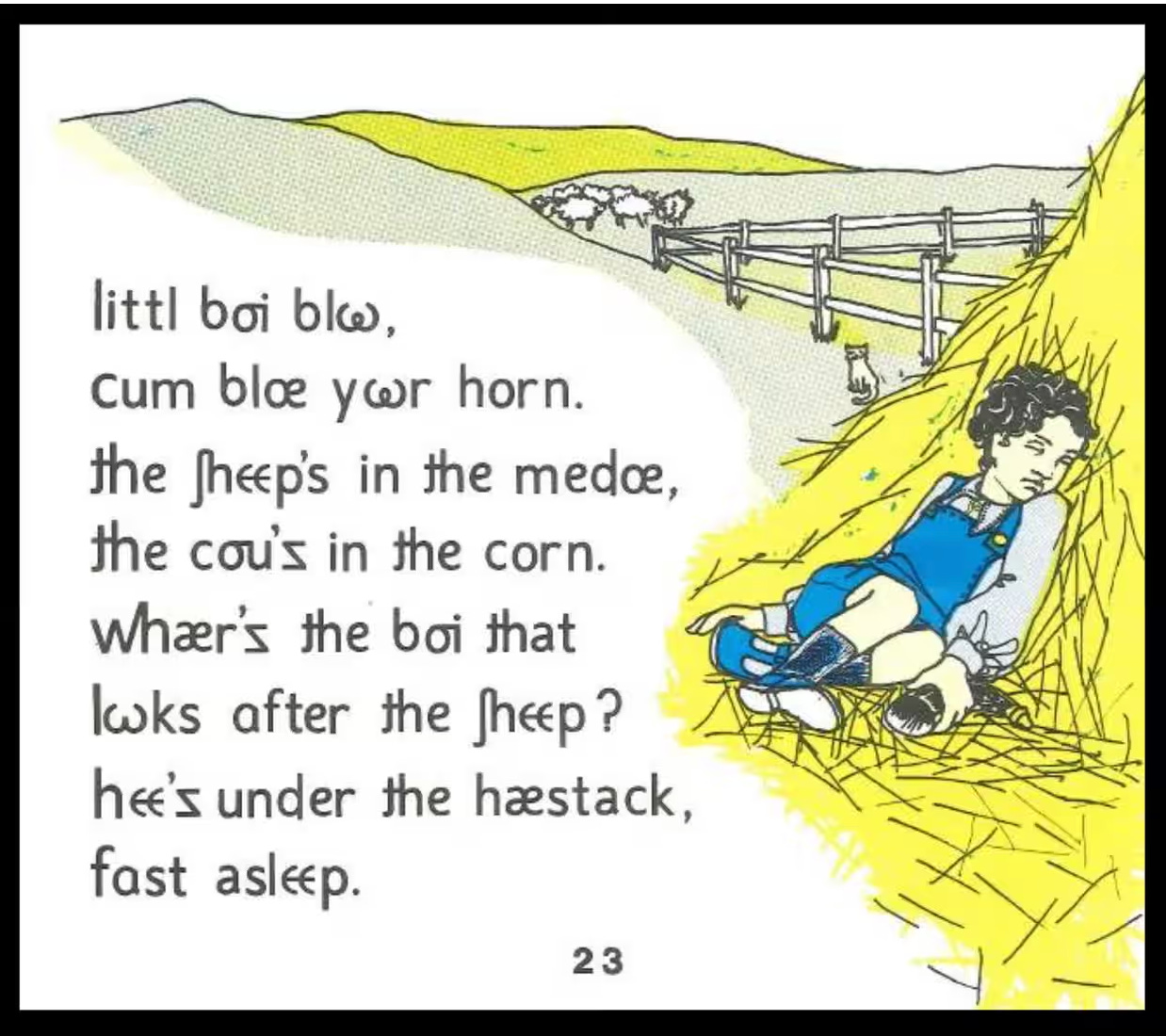
Online English language tests (like Duolingo’s) are worse than traditional tests in identifying students who will cope with study in English (Times Higher Ed—requires free registration)
How much English do migrant workers in the US really need? (LA Times, via Subtitle)

Julie Sedivy on ‘Why every utterance you make begins with a leap of faith’ (Psyche)
Cognitive neuroscientists at Brown University have been studying how gossip spreads, and how we keep it from spreading too far.
The ‘psychic significance’ of your Wordle starting word (ha ha) (The New Yorker)
Artist Chang Yuchen’s Coral Dictionary project (Walker; thank you, Jie Wang)

The US/UK expressions quick-fire round
More British:
Cushty Prat Cowston: British words I can no longer say in America (LitHub)
Fiscal, Procurator-Fiscal (WordOrigins.org)
More American:
The latest on pop/soda/coke (The Conversation)
Tarheel/rosin heel – love bug – Cajun/Acadian/Arcadian (WordOrigins.org)
Skedaddle – stand in/on line (Language Log)
Caboose (Sesquiotic)
Warning out (Fritinancy)
Fudge (Oxford English Dictionary)
Listen/watch here
Lingthusiam asks the perennial question Is a hot dog a sandwich?
Public-speaking coach Bill McGowan on how to captivate an audience (People I Mostly Admire)

From the archives
Food words are among the most variable words within English, not just in terms of what we call foods (courgette/zucchini and the like), but what we mean when we call foods. Harking back to some of the links above, here are some that go deeper into the US/UK differences:
Burgers and hot dogs (there’s a subtle difference in how these are conceptualised, and that makes for linguistic differences)
Sandwiches (can they be made with bagels? can they be ‘on’ toast?)
Fudge (what’s its consistency? what colo[u]r is it?)
Joke of the month
A supercut of American comedian Jason Mantzoukas facing British English on Taskmaster.
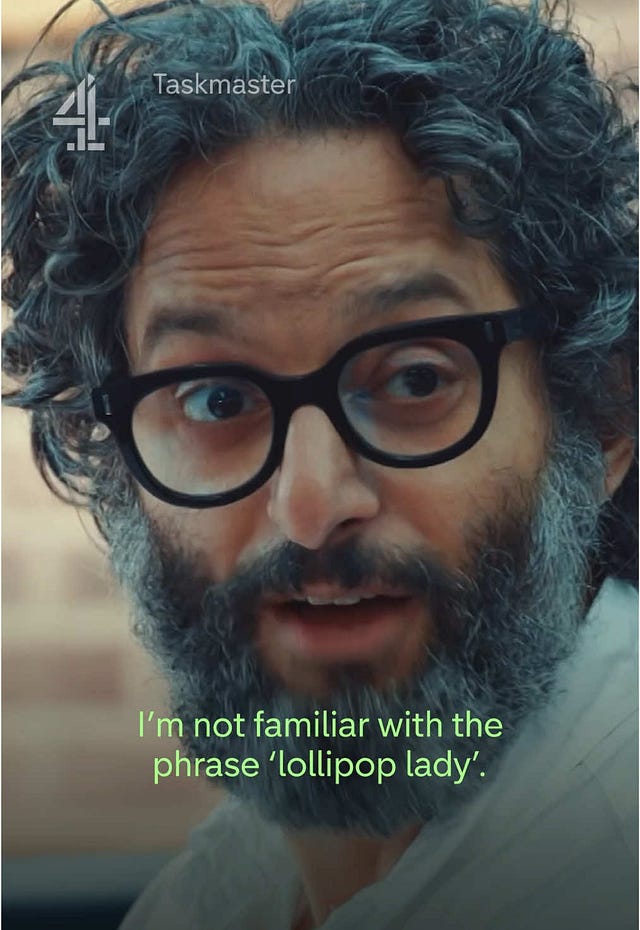
 Tiktok failed to load.
Enable 3rd party cookies or use another browser
And, fitting for this month’s post, it includes the phrase small print!
smack barm pea wet